Wordgrams - Crossword & Puzzle
- 4.6
- Rating
- 1.00M
- Installs
- Free
- Price
 Analysis by App-foxy
I went into Wordgrams - Crossword & Puzzle expecting a pleasant way to fill a few spare minutes, and that is exactly where it makes the strongest first impression. It is a free word game from FunCraft Games built around crossword-style play, with a clean enough idea to understand quickly: open a puzzle, work through the clues, and keep your brain occupied without needing a long setup. The store summary calls it a way to exercise your brain, but I found its real appeal more practical than that. It gives you a small, repeatable mental task that fits naturally between other parts of the day.
The important question, though, is not whether the game is enjoyable during the first sitting. Most casual word games can manage that. The better test is whether it still feels worth opening after the novelty has gone. My experience is that this game can earn that place for people who like a steady crossword routine, especially if they enjoy solving at their own pace rather than chasing an intense action-game loop. It is less convincing for players who need constant surprise, deep customization, or a strong sense of progression.
Why the first week feels so approachable
The opening appeal comes from the low barrier to entry. You do not need to learn a complicated control scheme or understand a large fictional world before starting. The central activity is familiar, and that makes the game easy to recommend to someone who already enjoys newspaper crosswords or mobile word puzzles. I could pick it up when I had only a short break, make some progress, and put it down without feeling that I had abandoned an important session.
You May Also Like

 Blood Strike: 2.5 Anniversary
Blood Strike’s Loadouts Turn Every Drop Into a Tactical Gamble
A close look at Blood Strike’s custom loadouts: how fast access to signature weapons reshapes its battle royale rhythm, rewards preparation, and narrows the gap between fights.

 Pandora - Music & Podcasts
Pandora’s Music Is Easy to Start, but Harder to Recover
Pandora’s strength is its low-effort path from a seed to a station. Its weak spot is how much confidence it asks you to place in connection, setup, and quiet recovery.

 8 Ball Pool
 Is Built on Rivalries, Rematches, and Routine
A close look at the rivalries, rematches, shared routines, and unanswered safety questions that turn a quick pool match into a persistent mobile community.

 Samsung Music
’s Quiet Strength Is Playing What You Already Own
Its reach comes less from spectacle than from dependable access to a personal library. That simplicity is both the app’s strongest retention engine and its ceiling.

 AccuWeather: Weather Radar
AccuWeather Review: A Quick, Clear Forecast for Everyday Decisions
For everyday plans, the best forecast is the one you can understand quickly. AccuWeather makes rain timing, radar, and local conditions easy to act on, with a few trade-offs.

 Hill Climb Racing
Why Hill Climb Racing Still Turns Crashes Into One More Run
A tiny car, a bumpy hill and one more upgrade: Hill Climb Racing keeps resurfacing because its simple chaos makes every near-miss feel personal.
More From Our News Desk



That flexibility matters in an everyday situation. Imagine waiting for an appointment with enough time to be bored but not enough time to commit to a full game. A crossword puzzle gives you a focused alternative to scrolling, and the format is naturally divided into manageable decisions. I found myself using it in the same way during quiet moments at home: not as the main event of the evening, but as a small mental reset after repetitive work.
The game is listed as free, which makes trying it straightforward. There are in-app purchases ranging from $0.99 to $99.99 per item, so I would still approach the payment side with awareness rather than assuming every part of the experience is equally unrestricted. For a casual player, the sensible approach is to begin without spending and decide whether the basic routine is genuinely useful before considering any optional purchase.
Its Everyone age rating also makes the tone broadly accessible. That does not mean every clue will be equally easy for every player, of course. Word knowledge varies considerably with age, reading background, and familiarity with different expressions. I would be comfortable suggesting it as a shared puzzle activity for a household, but I would not assume that a younger player will automatically find every clue suitable in difficulty simply because the age label is open.
The early learning curve is gentle, but the clues still matter
What I liked during the first week was that the game lets the crossword format do most of the teaching. The grid, clue relationship, and crossing letters provide a natural feedback system. When I was unsure about one answer, I could often make progress elsewhere and return with more information. That creates a useful rhythm: solve the obvious entries, use them to narrow the difficult ones, and avoid treating one stubborn clue as a complete roadblock.
That is also my first practical tip for new players: do not spend too long trying to force a single answer. Fill the clues you recognize, then use the crossing letters as evidence rather than guessing from the first word that comes to mind. This approach makes the game feel less like a test of instant recall and more like a process of elimination. It is a small change, but it reduces frustration considerably.
The early sessions can be especially satisfying because each solved section confirms the next decision. That feeling is familiar to crossword fans, yet it works well on a phone because the game is always close at hand. I also appreciate that the format does not demand the same physical attention as a fast arcade game. It is suitable for quiet concentration, and I can pause mentally without losing the entire point of the session.
Where it differs from ordinary crossword alternatives
Compared with a printed crossword, the mobile version is more convenient and less tied to a particular publication or piece of paper. I do not need a pen, an eraser, or a flat surface. The trade-off is that the phone itself can become a distraction. A newspaper gives me one deliberate object; a smartphone offers notifications, other apps, and the temptation to leave the puzzle whenever the answer becomes difficult.
Compared with a general word-search game, this format asks for more interpretation. A word search often rewards visual scanning, while a crossword depends more on language, memory, and the relationship between answers. That makes Wordgrams a better fit for someone who enjoys clues and deduction, but a weaker choice for anyone who mainly wants a relaxing activity with almost no uncertainty.
It also occupies a different space from competitive word games. If you want direct matches, a visible opponent, or the pressure of a timer, this is unlikely to replace that experience. Its strength is the quieter loop. I would choose it when I want to think without feeling watched or rushed, and choose a competitive alternative when social tension is the reason I am playing.
What keeps it useful after the novelty fades
The long-term value depends on whether crossword solving is something you can turn into a habit. The game does not need to become a daily obligation to be worthwhile. In my view, it works best as a recurring pocket activity: a few puzzles during a commute, a short session before bed, or a way to give your attention a single target during an otherwise scattered day.
Its current version is 1.68.25152, and it supports Android devices running at least version 7.0. That makes the compatibility range practical for many Android users, although device performance and screen size can still influence comfort. On a smaller display, reading clues and checking the grid may feel more cramped than it would on a larger phone. I would give the game a short trial on the actual device you plan to use rather than judging the experience from another screen.
The game’s popularity suggests that the format has found a substantial audience: it has passed one million installs, with an average rating of 4.6 from roughly forty-seven thousand ratings and about five thousand written reviews. Those figures do not guarantee that it will suit every player, but they do support the idea that this is not merely a brief novelty with no staying power. I read the rating as evidence of a reliable core experience, not as proof that every puzzle or every session will feel equally fresh.
For me, recurring value comes from the way crossword solving changes with my own attention. A puzzle that feels difficult when I am tired can become manageable after a break. A clue I dismiss as vague may become obvious once a few letters are in place. That makes the same basic activity feel different depending on the moment, even though the underlying format remains stable. The game benefits from that natural variation more than from constant feature expansion.
A routine that avoids turning the game into homework
My preferred way to use it is to set a loose boundary before opening the game. I might solve until I reach a natural stopping point, or give it one short break in the middle of a busy afternoon. This prevents a casual puzzle from becoming another endless feed. It also makes the game easier to maintain because I am returning for a specific kind of mental break, not opening it automatically whenever I feel bored.
A second useful habit is to treat difficult clues as delayed problems rather than failures. I leave them alone, work around the grid, and return later. That preserves the satisfying part of solving while avoiding the urge to spend money merely to escape one moment of uncertainty. If you are considering in-app purchases, this is the test I would use: first see whether you enjoy the thinking process itself, including the occasional pause, before paying to speed it up.
Another non-obvious advantage is that the game can serve different levels of attention. When I am alert, I can focus on the wording of clues and look for precise answers. When I am mentally tired, I can simply fill the easier entries and stop. That makes it more adaptable than a puzzle that requires full concentration from the first move. The limitation is that a low-energy session may feel more like maintenance than entertainment, so I would not force myself to play every day.
The maintenance burden is low, but not invisible
There is no elaborate collection of equipment, account management, or physical materials to maintain from the player’s point of view. The main upkeep is simply keeping the app available on a compatible Android device and deciding how much attention you want to give it. That is a strong point for a game intended to become part of a routine. It does not ask me to reorganize my life around it.
Still, the free-to-play structure introduces a different kind of maintenance: attention to spending. The purchase range reaches from $0.99 to $99.99 per item, which is wide enough that I would be careful on a shared device or when allowing a child to play. Even if the puzzles are the main attraction, optional purchases can change the way a player approaches difficult moments. I prefer to keep the solving process intact and regard assistance as an occasional choice, not a default solution.
There is also the maintenance of interest. Crossword games can become repetitive when the solving pattern stops feeling rewarding. To keep the experience healthy, I would alternate it with another kind of activity instead of expecting it to provide unlimited stimulation. A short word puzzle is valuable partly because it has a defined shape. If I play for too long, that same simplicity can start to feel narrow.
The installation footprint is not the only practical consideration. Screen readability, typing comfort, and the interruptions of a phone all affect whether the game remains pleasant month after month. Someone who mostly plays on a tablet or larger phone may find the grid easier to live with than someone using a compact handset. That is not a flaw in the puzzle design itself, but it is an important part of the long-term decision.
What creates fatigue over time
The biggest source of fatigue is not the basic crossword concept; it is the possibility that the routine becomes predictable. Once I understand how I normally approach the clues, the emotional curve can flatten. The first few solved entries may still feel good, but the session can lose momentum if too many clues seem similar or if I am relying on the same familiar answers.
There is a second kind of fatigue that affects players who dislike uncertainty. A crossword can leave me with a nearly completed grid and one answer that refuses to cooperate. That is satisfying when I eventually solve it, but irritating when I am in a hurry. People who want immediate, visible progress may prefer a word game with simpler rounds. Wordgrams is better for players who accept that a little friction is part of the pleasure.
Some players may also tire of playing alone. The game’s appeal, as I experienced it, is primarily personal concentration rather than conversation or competition. If your ideal mobile game includes a lively social layer, direct challenges, or constant interaction with other people, this may feel quiet to the point of being limited. I would not choose it as a substitute for a multiplayer word game when shared play is the main goal.
Finally, the purchase structure can affect the feeling of relaxation. Even when I am not buying anything, knowing that optional items exist can make me more conscious of how the game handles difficulty. My advice is to decide in advance whether you are willing to spend at all. A clear personal rule removes much of the mental noise and lets the crossword remain the focus.
Who should make room for it, and who should skip it
I think it is a good match for crossword beginners, casual puzzle fans, and people who want a quiet activity that can be started and stopped easily. It is also suitable for someone trying to replace a few minutes of aimless scrolling with a task that requires language and attention. The free entry point makes experimentation reasonable, while the Everyone rating keeps the audience broad.
I would be more cautious recommending it to players who need a strong narrative, dramatic audiovisual rewards, or a constantly changing set of mechanics. It is also not my first choice for someone who wants a completely offline-feeling paper experience, because a phone carries the usual distractions and the free-to-play context. Dedicated crossword enthusiasts may still prefer a publication or specialized puzzle source if they care about a particular editorial style or a more traditional solving environment.
For families, I would use it as a cooperative conversation starter rather than assume everyone will enjoy playing independently. One person can read a clue aloud, another can suggest possibilities, and the crossing letters can settle disagreements. That turns a solitary phone game into a small shared activity without requiring the game to provide a formal multiplayer mode. The trade-off is that the screen and controls may not be ideal for several people gathered around one device.
My long-term verdict
After the first-week charm wears off, Wordgrams remains worthwhile when you genuinely like crossword reasoning and value a calm, repeatable habit. Its lasting strength is not endless novelty. It is the dependable usefulness of a small puzzle that can fit around real life. I can imagine returning to it for a few minutes without needing to prepare, compete, or remember a complicated system.
That recommendation comes with boundaries. I would not describe it as an all-purpose word-game replacement, and I would not expect it to hold the attention of someone who needs constant social energy or rapid-fire variety. The free-to-play purchase range also deserves sensible limits, particularly on shared devices. If you protect the relaxed solving loop and avoid treating every difficult clue as something to buy your way through, the game is easier to appreciate on its own terms.
FunCraft Games has made a straightforward word title that earns repeat visits through accessibility rather than spectacle. Its 2021 release date places it beyond the initial launch phase, yet the current version and large installed audience show that it continues to occupy a stable place for many players. I see it as a maintenance-friendly companion for short mental breaks: not essential, not endlessly surprising, but consistently useful when the mood for a crossword arrives.
My recommendation is simple: try it if you want a free crossword habit that fits into small gaps in the day, and give it a fair week before deciding whether the clue-solving rhythm suits you. Keep it if you enjoy returning to an unfinished challenge; skip it if you need competition, story, or constant change. For the right player, that modest promise is enough to give this game lasting space on a phone.
FAQs for Wordgrams - Crossword & Puzzle
01What is Wordgrams - Crossword & Puzzle, and how does it work?
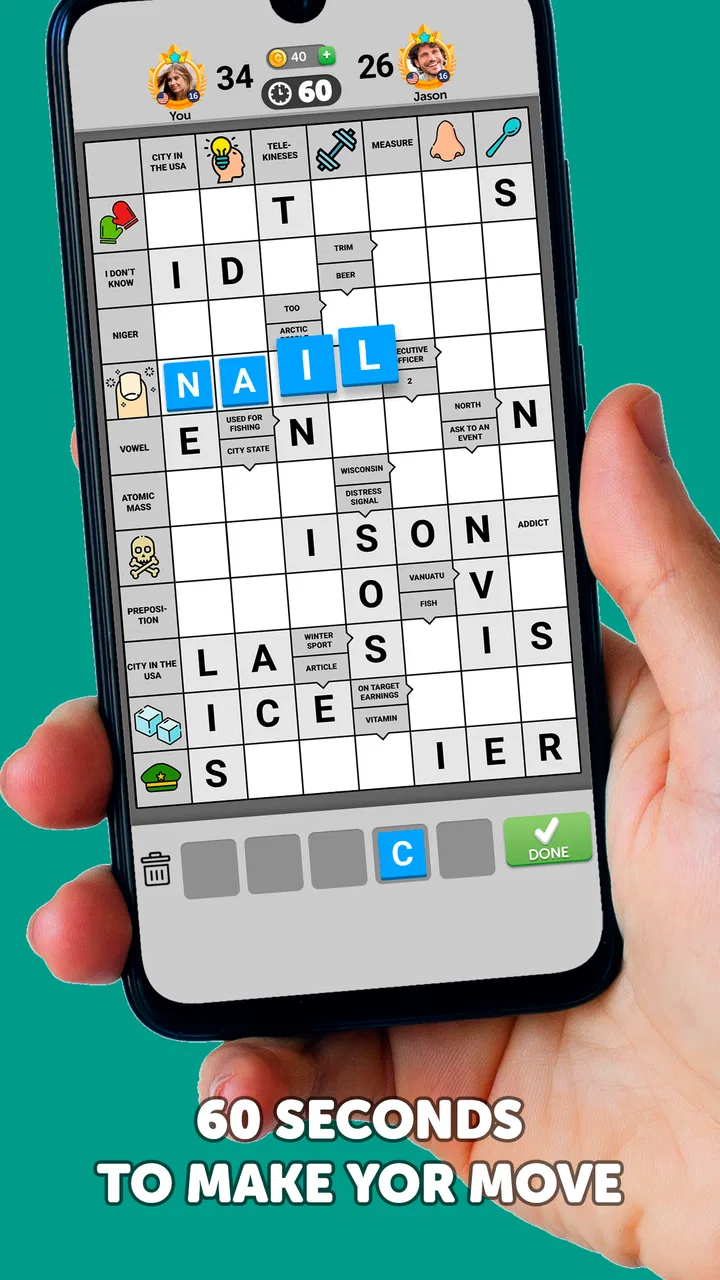
Wordgrams - Crossword & Puzzle is an engaging word game that combines crosswords and puzzles. Players create words by strategically placing letters on a board, aiming to outscore their opponents. The game offers various modes, including solo challenges and multiplayer matches, allowing users to enhance their vocabulary and strategic thinking skills.
02Is Wordgrams - Crossword & Puzzle free to play?
Yes, Wordgrams - Crossword & Puzzle is free to download and play. However, it offers in-app purchases for additional features or to remove ads. These purchases are optional and not necessary to enjoy the full experience of the game. Players can still access most features without spending money.
03What are the key features of Wordgrams - Crossword & Puzzle?
The app features a variety of game modes, including solo challenges, multiplayer matches, and daily puzzles. It also provides a hint system to assist players when they’re stuck. The intuitive interface and colorful design enhance the gaming experience, making it enjoyable for both casual and competitive players.
04Can I play Wordgrams - Crossword & Puzzle offline?
Wordgrams - Crossword & Puzzle requires an internet connection for most features, especially multiplayer modes. However, some solo challenges may be available offline, allowing users to play without an active connection. It's best to check within the app for specific offline capabilities.
05Are there any social features in Wordgrams - Crossword & Puzzle?
Yes, Wordgrams - Crossword & Puzzle includes social features that allow players to connect with friends and compete against them in multiplayer matches. Players can also share their achievements and progress on social media platforms, enhancing the interactive and competitive aspect of the game.
Pros
- Engaging mix of crossword and word search.
- Daily challenges keep content fresh.
- Visually appealing and user-friendly interface.
- Multiplayer mode for competitive fun.
- Helpful hints available for tricky puzzles.
Cons
- Occasional ads can disrupt gameplay.
- Limited free hints without in-app purchases.
- Requires internet connection to play.
- Some puzzles can be repetitive.
- In-app purchases can be pricey.

Wordgrams - Crossword & Puzzle
Gallery